“Power is Nothing if it is not the Power to Choose”: Cognitive Sovereignty as Prime AI Ethics Principle.
 Katja Rausch
9 min read
Katja Rausch
9 min read
In the era of automated decision-making without understanding, the sovereignty spectrum spans wide. From data sovereignty to AI sovereignty to cloud sovereignty to algorithmic sovereignty to cyber sovereignty, multiple sovereignties collide and converge.
They all run through the dynamic business intelligence pipeline and create a fabric of manifold people-connector flows within any data-driven company. However within the spectrum of sovereignties one crucial and centripetal sovereignty stands out and reigns. The mother of all sovereignties: cognitive sovereignty.

“Science promised man power. But, as so often happens when people are seduced by promises of power, the price is servitude and impotence. Power is nothing if it is not the power to choose.” [Joe Weizenbaum]
But what exactly is the spectrum of cognitive sovereignty? How does is span from individual cognitive sovereignty to proprietary collective enterprise knowledge optimisation (EKO)? Why there is a need for individuals and businesses to recalibrate their epistemic cursor and focus more on knowledge than intelligence.
Sovereign, what it meant then and today.
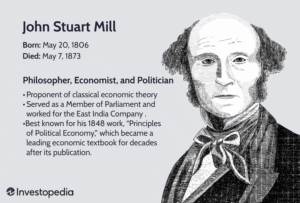
Some 150 years later, The Institute for Cognitive Sovereignty goes further and writes:
“Cognitive sovereignty is the ability to direct your own attention, to think your own thoughts, to resist manipulation – in a world engineered to prevent exactly that.”
Today we generally understand cognitive sovereignty as the capacity of a person, community or nation to control and manage its own knowledge, attention, and decision-making processes.
This article argues that in the age of AI supremacy, which threatens our social, human and economic independence and interoperability, we need to pause and raise the crucial question of how to protect and preserve our human reasoning capacities and cognitive sovereignty. Second we look at the lurking dangers of professional deskilling, cognitive atrophy and domain expertise paralysis as the result of the over-use of genAI usage, collaboration and dependency. Finally, the article invites businesses to consider enterprise knowledge optimisation (EKO), and how “semantic layers” can be a game changer in the quest for collective business knowledge sovereignty.
The inflection point: intelligence vs knowledge
With the recent switching off and worldwide suspension of Anthropic’s Fable 5 and Mythos models ordered by the US Government we have reached an inflection point. More than just a wake-up call for governments, businesses, and people alike, it is a brutal kick to undock from the centralised IT brains.
The imperative for independence, autonomy and move from data ownership to knowledge sovereignty.
At The House of Ethics, we have been arguing for a while that people, businesses and governments need to reconquer their cognitive terrain and protect proprietary knowledge pools. Beyond intelligence, knowledge has become key.
This phenomenon is critical as guardrails, regulations and ethics have proven to be ineffective against ubiquitous epistemic genAI bulldozers.
Resistance might not come from any outside tech (such as again a new “world” model) but from our inner human “cognitive” immune system.
And the understanding of how cognitive sovereignty might be the key trigger to collective business and ethical rethinking in the light of distributed innovation.
Cognitive Sovereignty: the first principle of AI ethics.
It feels odd to write that human thinking not only should be a human right but a fundamental ethical duty. The reason for this radical claim is that the protection and the preservation of our humaneness and national, business and individual sovereignties are at stake. Data, AI and cybersecurity sovereignties all being a sub-category of the later.
We have designed the Cognitive Sovereignty Quadrant, a practical pulse check to gain a global overview of a company’s state of cognitive sovereignty.
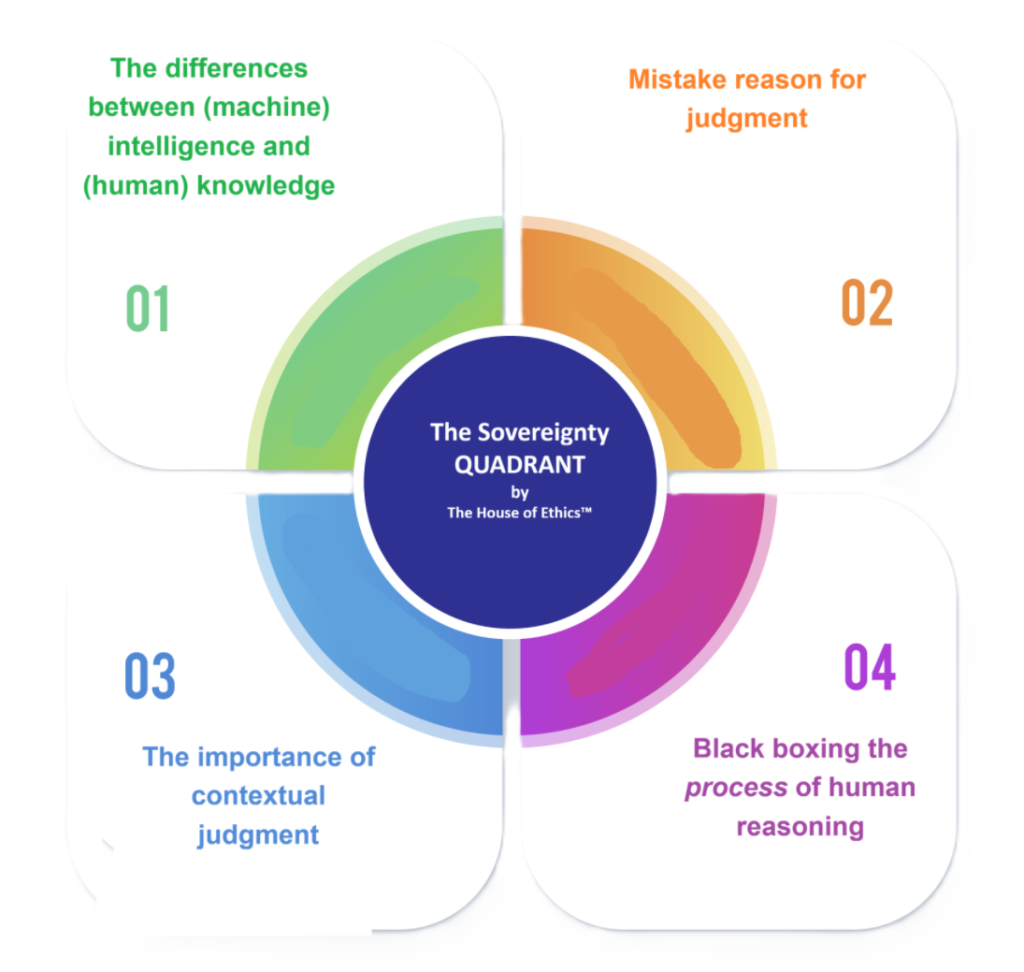
First: Understand the differences between (machine) intelligence and (human) knowledge.
Machines excel at scale, memory, and pattern detection but are brittle to distributional shifts and systemic risks like data drift or adversarial inputs; humans on the other hand are slower but more robust while embracing novelty through flexible reasoning and meta‑cognition. We are capable to relate concepts intuitively without training nor coding, and ultimately understand the limits of a reasoning.
Human knowledge is biological, contextual, embodied, and value‑laden; machine intelligence is engineered from datasets, statistical, data‑driven, and task‑specific sources. Humans generate meaning through experience, social learning, and moral judgment; machines optimise patterns and pursue computational goals based on computational directions without intrinsic understanding.
But there is also a difference between machine intelligence and machine knowledge. Machine Intelligence encompasses the algorithms, models, and procedures that infer, predict, optimise, and act. Machine knowledge stresses on the representations, facts, patterns, and models encoded in data, weights, ontologies, or databases.
Machine intelligence is the set of algorithms and processes that perform tasks resembling cognitive functions; machine knowledge is the structured, stored, and retrievable information those systems use and produce.
The concept of cognitive sovereignty can thus not be applied to machines since they are developed by an agent either human, business or digital, and have an outside, controlling providence.
Second: Mistake reason for judgment
At this point we refer to Joe Weizenbaum’s legendary book “Computer Power and Human Reason: From Judgment to Calculation” (1976) where the conceiver of the ELIZA program underlines the most important differences between human and machine thinking: machines separate and humans choose.
For Weizenbaum, the reasoning of machines refers to formal logic, pattern recognition, rule‑based inference. We certainly are capable of it too but on a different scale. What machines lack, and the legendary computer scientist and professor at MIT heavily stresses on this important distinct: they cannot exercise judgment.
Human judgment integrates ethical commitments. Judgement requires lived experience, contextual understanding, and emotional intelligence like empathy to name just one.
Humans are also capable of moral discernment or understanding the importance of responsibility or accountability while pursuing a goal, defining a purpose or having a vision.
For Weizenbaum the verdict was crystal clear: some decisions simply “ought not to be made by machines.”
The damage can have disastrous effects since risks are mapped within an entire system, with high-speed and large-scale rippling effects through the entire ecosystem. In healthcare for example, when clinicians mistake AI’s reason for judgment, consequential systemic risks might emerge, and that’s exactly the collapse Weizenbaum feared.
In this brief example, we can point to ethical shortfalls through the automation of inequity as AI may reproduce biased patterns without understanding their injustice; the danger of moral outsourcing where decisions that require human values become mechanised. But the erosion of clinical agency triggers a more fundamental danger: professional deskilling. If clinicians may defer to AI even when their intuition says otherwise, the symptoms of professional deskilling already set in.
Deskilling ramps slowly but has disastrous effects on professional exceptionalism and domain-specific human knowledge. Knowledge being the meta-structure of rendered intelligences.
Third: The importance of contextual judgment
Both humans and machines can retrieve contextual background information that situates data or information. This ultimately produces a type of knowledge. For machines it can be built in through architectural choices like “semantic layers”, ontologies or models running on neuro-symbolic data. Such architectural design choices run through the infrastructure of multi-model or multi-agentic AI. In this process data provenance, patient demographics, device settings, clinical workflows, and historical events are not just correlated but also interpreted.
In “What kinds of knowledge will save you from AI?” Faisal Hoque argues that two types of human knowledge are very specific to humans and cannot be produced by machines: contextual judgment and procedural knowledge.
Contextual judgment is different from detailed or deep expertise, thus very specific to humans.
It “can’t be looked up, and current models are far less reliable at this type of inference than at the recorded-knowledge reasoning they have already mastered. It may not stay out of reach forever, but it is not the threat knowledge workers face today. “
Procedural knowledge, on the other hand is the “knowing how” and the “kind of knowing that lives in the doing”. And names it: “trust, authority, the ability to read and relate to other humans—that exist only between people.” By pointing to the lacking links in data, intelligence and knowledge processing and production by machines, we can capitalise on building the foundational grounds of cognitive sovereignty.
Forth: Black boxing the process of human reasoning itself
Losing the ability to go through the entire cycle of human reasoning – comprehending the issue, gathering information, analysing, scoping out solutions and finally evaluating and ranking for contextual relevance and feasibility – is a crucial process of knowledge creation and reasoning training.
Not just focusing on the content but training the techniques to read and understand the reality. The over reliance of automated decision-making has interrupted the human reasoning loop. Calling probabilistic tokenisation by generative AI and AI models running on “Black Boxes” as “intelligence” and knowledge engines is misleading,
At the worst the process of reasoning is lost on two levels: first, those who used to think problems through, structure texts and analyse situations, but now rely on genAI to think faster or be more productive. They risk the atrophy of their cognitive thinking. Second case, those who never were introduced to logical process thinking, and just rely on generated AI outputs; they will never learn how to reason the process. Between loss and lack, the harm is colossal.
Especially in digitally uncertain and frail business ecosystems where workflows, processes and decision-making are progressively automated and outsourced to AI systems, human cognitive sovereignty, the power to choose and the ability to comprehend the impact and consequences of decisions must come first. Why?
Because upholding a fair, responsible, accountable, and sustainable future must come first. And cognitive sovereignty is the key enabler to such a collective outcome.
Where to start, and what companies can practically do to prevent cognitive erosion and deskilling?
We invite to two distinct but complementary incentives. Each can be developed in-house without outsourcing any critical infrastructure.
First, on a people intelligence basis, train your people on a prompting & reasoning programs to carve out the importance of protecting independent thinking. The publicly available ACES program is one of such frameworks that can help you build a tailor-made program for your teams. ACES stands for Awareness (asking what went into the AI), Comprehension (pressure-testing logic), Expertise (knowing how to dispute outputs), and Scale (making these checks business-as-usual). ACES trains employees on deeper reasoning and Socratic ethics by focusing on practical cases and the importance of explaining the “reasons”, the meaning-laden “why” behind recommendations rather than blindly copy-pasting the AI-generated average-output “what.”
These are the foundational requirements for sustainable human agency in an automated and augmented era. The central challenge shifts from technical capability to the power of choosing.
Second, connect all your collective organisational knowledge assets and consider developing a “semantic layer” to align, explore, combine and understand cross-domain knowledge.
The IT- or data-centric approach is highly problematic for just any industry. The real knowledge about your business does not solely sit in data. Crucial knowledge is to be found in content scattered in HR, Legal, Marketing, Logistics, Procurement etc. And held by humans, the uniqueness of human knowledge and knowledge transmission amplified through expertise, relations with clients, suppliers, emotional intelligence, cultural differences in markets.
What does a semantic layer actually do? It provides a holistic way of handling content, aligning concepts and managing meta-data about an organisation’s domain and far fetched product / service processes and value chains. Thus create interoperability between machine-readable data and human intelligence for hybrid knowledge.
4V data – variety, velocity, volume and veracity – accumulates heterogenous sources but no standardised readable meaning and does not translate into a general understanding across the organisation. This is where Enterprise Knowledge Optimisation (EKO) steps in. And amplifies the strategic benefits of semantic layers.
Cognitive sovereignty is a core enabler to lifting responsible business models above brittle and uncontrollable AI models. As pledged by The House of Ethics™, cognitive sovereignty is not merely a defensive posture against AI overreach but an offensive move to the preservation of the power to choose.